

“The future of the hobby won’t be decided by law, but by how willing we are to share.”
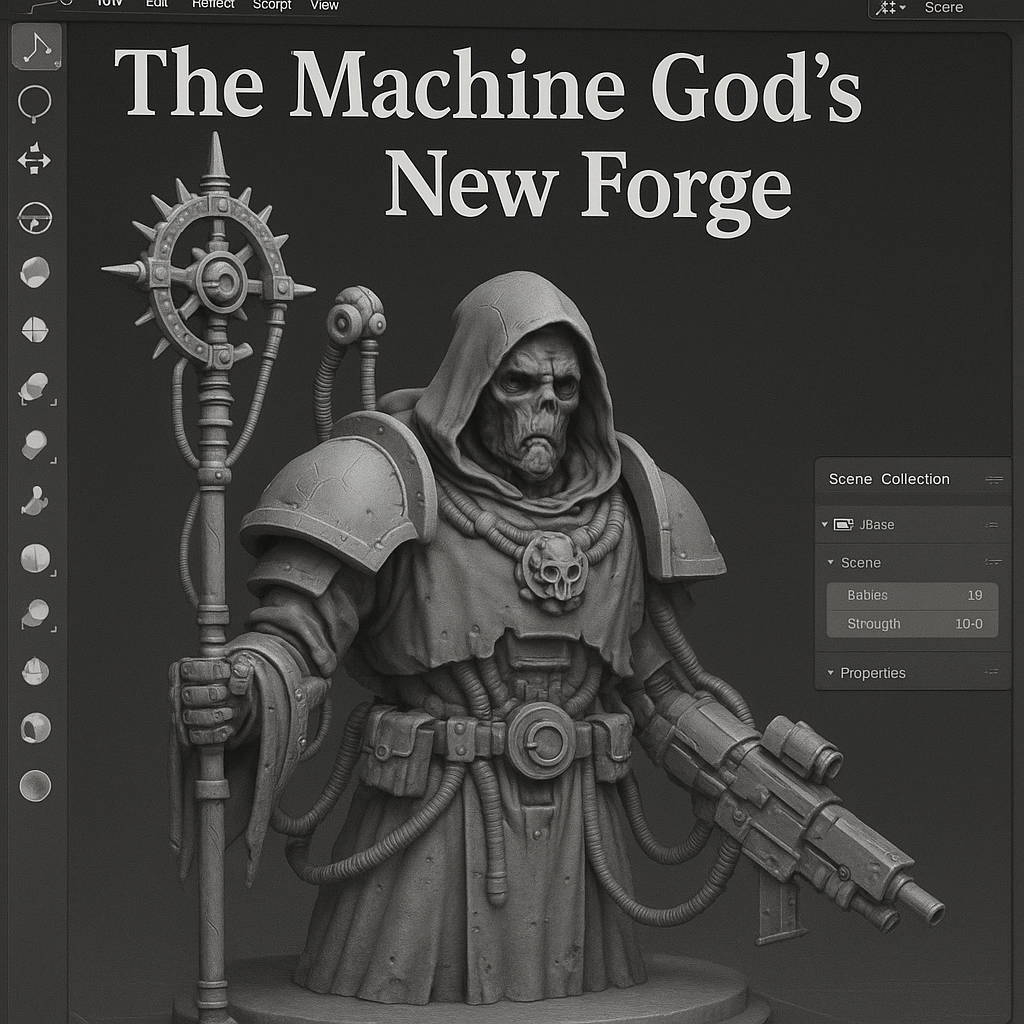
The Machine God’s New Forge
The legal war is the symptom. The deeper story lies in transformation.
Games Workshop has reached the same crossroad that music, film, and publishing once faced. It can continue to fight the tide or learn to ride it.
The world has already chosen creation over control.
The New Business of Imagination
Imagine a different strategy.
Instead of hunting down designers, Games Workshop could build a closed ecosystem where it provides both the printer and the files. A subscription platform where hobbyists print official models at home through encrypted digital access.
A resin printer styled like a Mechanicus relic. Files streamed securely from a central database. Hobby stores repurposed as local repair and service hubs.
The model is not hypothetical. It already exists in software, film, and gaming. Microsoft’s Game Pass turned ownership into access. Spotify turned piracy into subscription. Netflix made scarcity irrelevant.
Games Workshop could do the same.
It’s not heresy. It’s evolution.
“If the Machine God could print, he’d subscribe too.”
The Numbers Behind the Dream

Let’s do the math.
A £20 monthly subscription equals £240 per player annually. Two hundred thousand subscribers would yield nearly £48 million in recurring revenue. Add another £10 monthly for resin and filament, and you climb past £72 million. Digital expansions, exclusive models, and lore subscriptions could add millions more.
This approach replaces unpredictable spikes in sales with stability. Investors love stability. Fans love access.
It also creates an ecosystem where piracy becomes effort, not temptation.
Lessons from History
Kodak ignored its own digital camera invention to protect film and died. The music industry sued its customers before learning to sell them convenience.
The same choice faces Games Workshop. It can either become the streaming platform of miniatures or the relic people remember fondly as they print something new.
The Cultural Shift
Beyond business lies culture. For players, 3D printing isn’t rebellion. It’s creativity. It’s the same instinct that once drew them to painting and converting models. They are not destroying the hobby. They are extending it.
Warhammer has always thrived on participation. The lore survives because players fill in the gaps. The factions evolve because fans write their own legends. The act of creation has always been shared.
The company’s future will depend on whether it chooses to see that as competition or collaboration.
Fear, Power, and Legacy
At the core of this tension lies a shared human fear: the fear of irrelevance.
Games Workshop fears losing control of its universe. Artists fear losing the right to exist within it. Players fear losing the sense of belonging that made them fall in love with the hobby.
Every act of creation carries that same risk. Once shared, art stops belonging to its maker. That is both the terror and the beauty of imagination.
The real danger for Games Workshop is not piracy. It is nostalgia. The belief that its power lies in holding the past instead of inventing the future.
A Future Worth Building
The answer is not to dismantle the forge but to rebuild it.
Games Workshop could establish official creator programs, licensing independent artists, sharing revenue, and integrating their designs into the ecosystem. A hybrid model that turns rivals into collaborators.
It could partner with printer manufacturers to produce lore-themed machines. It could transform Warhammer stores into maker spaces, where printing, painting, and storytelling coexist.
That approach would honour both the spirit of the hobby and the logic of survival.

The Moral of the Forge
Every generation faces the same dilemma. Do we protect what we made or share it so that it grows?
In mythology, the Machine God represents knowledge turned sacred. To worship the forge is to accept transformation. The same applies here. The act of creation cannot be controlled forever. It will spread, reshape, and sometimes rebel.
The future of Warhammer, and of the miniature industry itself, will depend on how gracefully it learns to share.
The Machine God provides, yes. But the forge now belongs to everyone.
And perhaps that is not the end of an empire, but the beginning of something new.

Comments are closed